
Sandal – Redefining Comfort
The Break-In Process: The Complete Guide
The wearing-in phase for Hermès sandals is real and significant. It is not an urban legend. New Hermès sandals — specifically the Oran and Izmir in Epsom, Swift, or Nappa leather — are genuinely firm when first worn. This initial rigidity is a direct result of the leather quality — high-density calfskin does not deform under its own weight, unlike cheaper, thinner leathers that arrive soft because they lack the structural integrity to maintain their form under normal foot pressure. Hermès leather is firm because it is dense and well-structured — the firmness is a quality indicator, not a flaw.
The wearing-in procedure means the material progressively molding to your personal foot anatomy. The calfskin insole takes the impression of your foot’s pressure points, relaxing and shaping over repeated wearings. The top leather piece — the H-form upper — also relaxes where it contacts the foot surface and the toe sides. The heel strap in the slingback model softens at the contact point against the heel. Following five to ten uses, most buyers experience the sandal as significantly more comfortable than on the day of first wearing. After many regular wearings, the Hermès sandal often becomes among the most comfortable footwear owned.
Initial Wearings: The First Stage
The initial three uses are the hardest phase of the break-in period. Expect the leather to feel firm across the top of the foot, at the margins of the H-cutout, and at the heel contact area. The inner sole will also be stiff, particularly in the first few wears before the leather has molded to the specific form of your underfoot. The recommended approach for these initial uses is to keep wearing times brief — one to two hours maximum. This allows the leather to start molding to your foot without producing excessive friction hermes oran in the areas that have not yet softened.
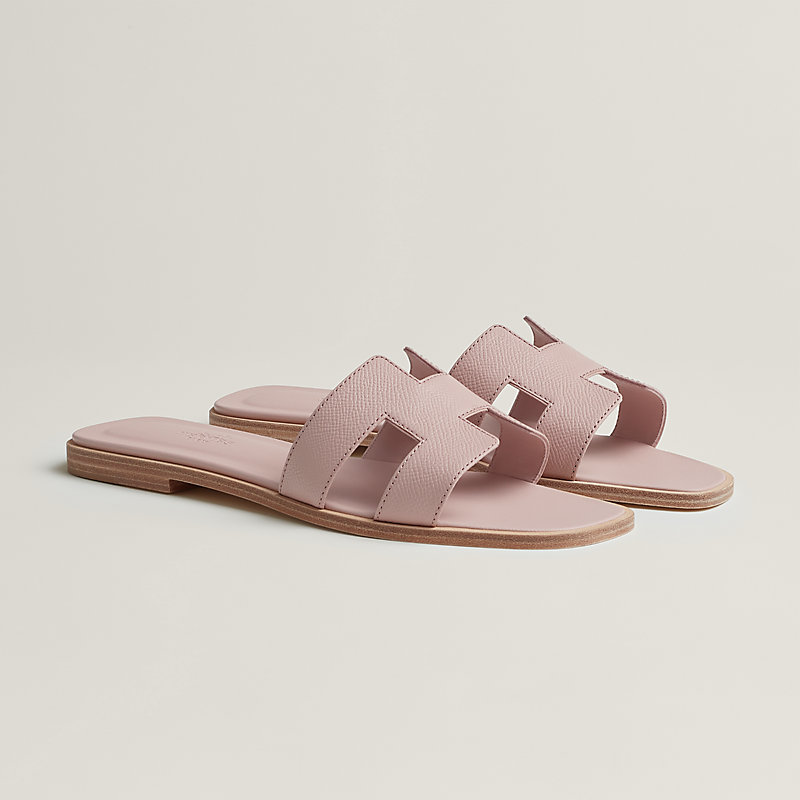
During this first stage, fine, thin cotton socks can be a useful aid — they minimize the contact rubbing at the firm contact areas without substantially affecting the break-in. This approach is particularly effective for the Oran’s slingback strap, which is the main area of rubbing during the early wearing period. It seems strange — a fine flat sandal and thin socks — but it is only for the break-in phase and more useful than any conditioning product at speeding up the break-in process at specific friction points.
The Progress Stage: The Leather Begins to Conform
By the fourth to sixth wear, most wearers describe a clear improvement in comfort. The leather is starting to adapt to the specific contours of the foot, and the inner sole is developing the foot’s shape imprint. The slingback strap (Oran) will have softened at its contact point against the heel and Achilles. The H-cutout edges will have adapted to the foot’s surface. By approximately a dozen wearings, most of the initial stiffness will have resolved, and the sandal will be noticeably more comfortable with each subsequent wearing.
From a maintenance standpoint, this is a good point in the process to treat the points of greatest contact with conditioning cream. A a little Saphir or equivalent conditioning cream used on the footbed and contact points after cleaning the leather and given time to soak in before the next use hastens the break-in. According to The RealReal‘s leather care content, consistent conditioning during the break-in phase reduces the break-in time by up to 30% while simultaneously protecting the hide from break-in stress.
Stage 3: Twenty Wears and Beyond: The Oran At Its Best
By the twentieth wearing, the leather break-in is largely complete for most wearers. The sandal has adapted to the individual foot form — the footbed has taken the impression of the sole’s pressure points and sits like a custom-made inner sole. The leather of the upper has softened at the contact points and stops generating discomfort where it meets the foot at the H cutout edges. The slingback strap sits comfortably against the Achilles. The sandal, in short, now fits you specifically. This is when at which most owners truly understand why Hermès leather goods have the longevity reputation they do: the sandal is at this stage more fitted than a synthetic or lower-quality leather shoe would feel after any number of wearings.